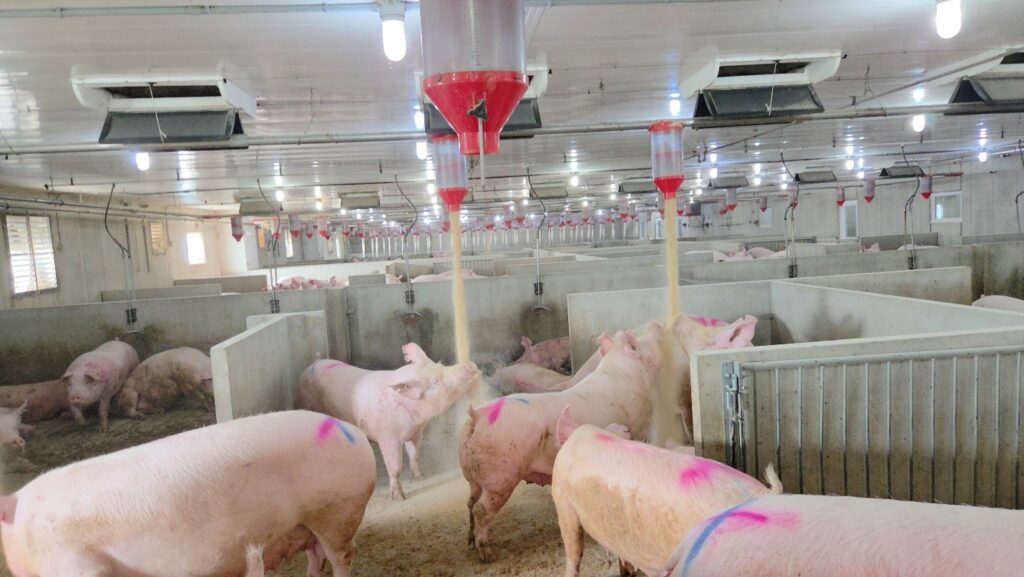
Feed group housed sows with little alteration to the existing feed lines following a retrofit.
Image courtesy of Dave DeVries. For more information on the DeVries Farm, click on the image.
Floor feeding is a simple method of providing feed to group housed sows. Some systems use multiple feeding sites and others use just one feeding site. Observations have shown that less aggression occurs when feed is evenly distributed over the floor. Intake will vary across dominant and submissive sows, as dominant sows push submissive sows away from the feed. Aggression levels can be high in floor feeding, but options for reducing aggression are available. Ideas such as using partitions between different feeding sites as well as providing adequate floor space and strategic timing of feed drops to attract dominant sows to feed will reduce aggression and increase opportunities for submissive sows to feed. Managing aggression in these types of systems is important for overall success.
Floor feeding management
Sows should be grouped by size/age/parity, ensuring that there is fair competition within groups. This can also help with managing a group’s feed requirements.
Groups should be kept small (generally 6-25 sows) and static, with no new animals being added after a group is formed. If an animal is moved to a hospital pen, she should not be returned to the original pen.
Feeding multiple times a day (3-8 drops) can reduce the incidence of feed-related aggression.
Keep sows in breeding stalls until 28-35 days after insemination, to ensure embryonic implantation.
It is very important sows are in good body condition before being placed in a competitive environment.
As floor feeding is a competitive feeding system, sows must be kept in static groups. Similar to short stall feeding, there is a opportunity for sows to gain access to more feed through aggression. Careful sorting of animals into groups based on size, age, and parity, as well as considering body condition, is important for the success of this system.
Good animal husbandry is key to the success of this system. Careful observation of sow behaviour and body condition through their time in group gestation is very important. Off-feed events can be detrimental to a pregnant sow. Provision of physical barriers and other enrichment is important to support the good welfare of sows in this system.
Training
No training is needed for the implementation of floor feeding. Social adaptation will occur naturally as the sows adjust to this style of feeding.
To accommodate floor feeding, pens must have a sufficient amount of solid floor space.
If working with larger groups of sows, ensure that there are an adequate amount of dividers to create numerous feed sites.
Ensure that feed is dropped over a wide area to prevent dominant sows from defending a large drop of feed. Reconfiguration of the existing feed system may be needed.
Allow 1.4 m² (15 ft²) of feeding area per sow in a pen.
Provide solid dividing walls to provide some separation while feeding and a place for sows to avoid conflict if necessary.
Ensure that drinkers are accessible by all animals.
Carefully consider the construction quality of dividing walls, as they will be leaned on and likely will be bumped into as sows fight to develop a hierarchy within the group.
BENEFITS
All sows can be fed at the same time.
No training is required.
Existing feed lines can be repurposed for this system.
Costs related to barn conversion or construction are reasonable.
Small groups of animals allow for easier observation.
Limited computerization and mechanization reduce the amount of time and money spent on upkeep and repairs.
CONSTRAINTS
Individualized feeding is not possible.
Feed wastage occurs at a higher rate.
More feed is required to maintain body condition.
Competing for access to feed can lead to injury .
Individual reduced feed intake can be difficult to detect.
Solid floors are required.
This system tends to decrease the number of sows that can be kept in a barn that previously used gestation stalls.